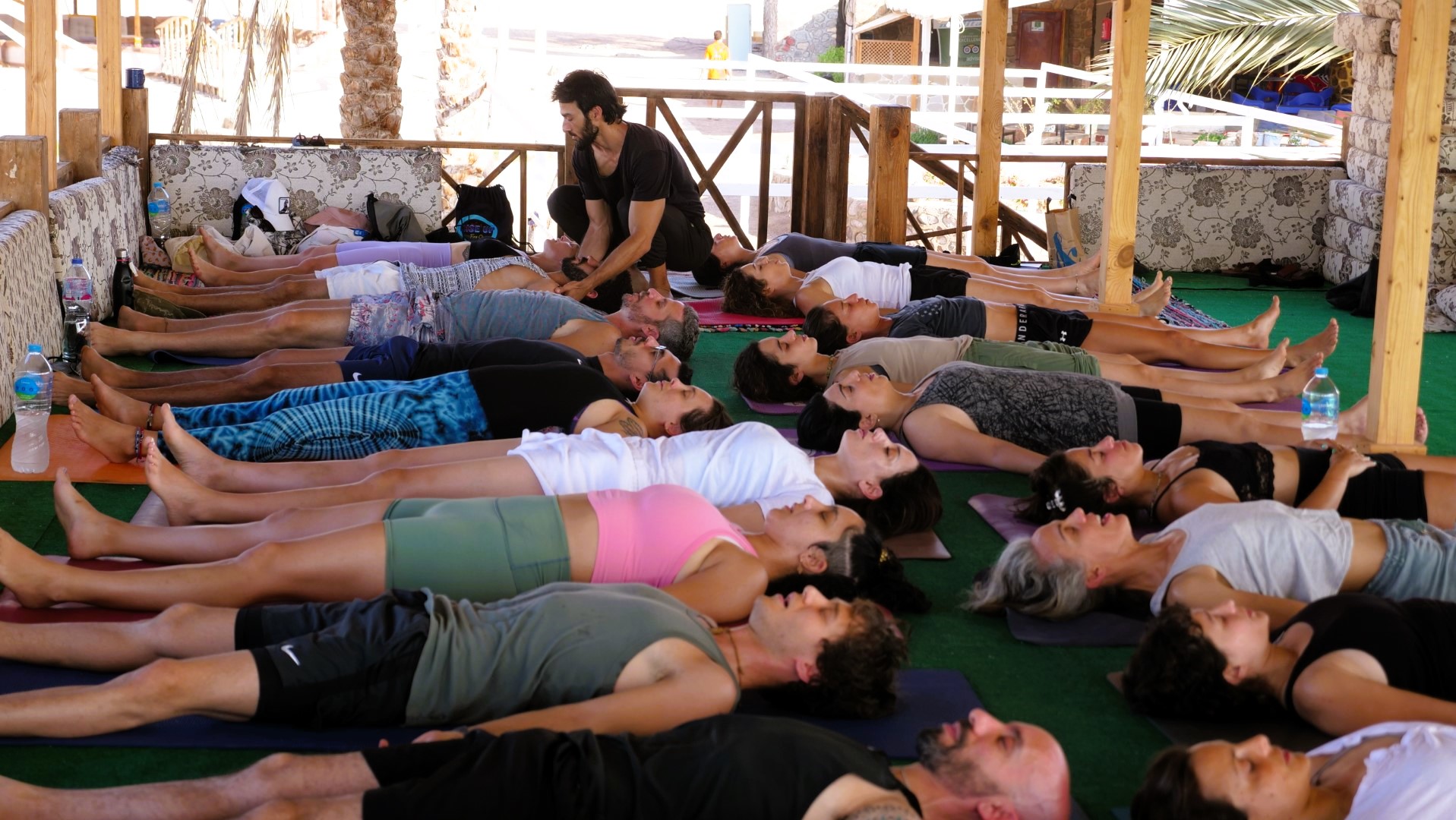
Breath Practice
In order to understand the benefits of breathwork it’s helpful to understand different breath technics and how to use them correctly. One goal is to use breathing practice to improve our level of health and psychophysiological awareness.
Breathing practice in Sanskrit (an ancient Indian language in which the yoga scriptures are written) is called pranayama. The message can be understood through the literal interpretation of the word pranayama:
Prana – life force, Yama – practice/control.
There are different terms and methods of breathing practices such as: circular breathing, box breathing, fire breathing, rebirthing, holotropic breathing, Wim Hof breathing, etc. It is important to emphasize that these are actually different techniques of breathing practices (or pranayama) with similar or different characteristics.
Stages of Breathing
Regulating the Nervous System with Breathing
Deepening and slowing the breathing rate activates the parasympathetic nervous system, which is part of the autonomic nervous system. As a result, the parasympathetic nervous system stimulates actions related to relaxation, recovery and preservation of the body. In other words, it helps bring the body back to a state of balance, order, certainty and allows for the release of defenses and growth.
Inhalation
Bringing in air.
Antar Kumbhaka
Breath retention with full lungs.
Exhalation
Expelling air.
Bahya Kumbhaka
Breath retention with empty lungs.
Inhalation
In a relaxed state, optimally, the breathing pattern will be deep and slow, diaphragmatic breathing that directs air to the bottom of the lungs so that the abdomen expands, then to the rib cage area and finally to the chest area.
In states of stress, defense, or uncertainty, the natural tendency is for breathing to become rapid, shallow and mainly focused on the upper part of the chest and throat, and sometimes stops completely. That is, cessation or freezing as a defense mechanism.
Exhalation
In a state of natural exhalation, the process of expelling air from the lungs will be slow and gradual. By default, we want the length of the exhalation to be as long as the inhalation or longer.
Exhalation Rate
The exhalation rate can be divided into three types:
- Slowed rate: A state where the exhalation is slowed down, like when pressing on the opening of a balloon and regulating the release of air from it, at a slower rate than the natural rate.
- Accelerated rate: Expulsion of air at a faster than normal rate by pushing and pressing the muscles, lungs and diaphragm, so that the air is actually pushed out faster than the body’s natural speed.
- Release: Expulsion of air from the lungs by voluntary release, like the fall of an object according to the rate of gravity. Note that this is a different state compared to “accelerated rate” because here it is about releasing the air and not pushing it.
The Ratio Between the Length of Exhalation and the Length of Inhalation
In the world of practice, there are several options regarding the possible ratio between the length of exhalation versus inhalation. The choice of a particular option depends first and foremost on the practitioner, the exercise itself and the goal that is being attempted:
- Equal length of inhalation, exhalation and retention (Sama Vritti Pranayama / Box Breathing): For example, 4-second box breathing.
There are also interesting options where the inhalation and exhalation are not equal:
- Exhalation longer than inhalation: 4-second inhalation, 4-second retention, 8-second exhalation, 4-second retention.
- Inhalation longer than exhalation: 8-second inhalation, 4-second retention, 2-second exhalation, 4-second retention.
Bandhas (The Locks)
The term “bandha” refers to “locking” or “binding” by contracting or activating specific muscle groups in order to channel the flow of energy, improve focus and also enhance the practice of asanas and pranayama.
Mula Bandha (Root Lock)
Muscle groups: Pelvic floor muscles (First Chakra)
Application: Creating awareness of the pelvic floor muscle area, drawing upward.
Mula Bandha is used when we are in standing postures, during inhalation, and during breath holds to create a sense of lift and stability from the base of the spine.
Uddiyana Bandha (Upward Abdominal Lock)
Muscle groups: Abdominal muscles (Second Chakra)
Application: After fully exhaling, pull the navel inward and upward toward the spine without inhaling.
Suitable mainly in practices involving breath retention after exhalation. Practicing Uddiyana Bandha creates a vacuum that draws energy upward.
Jalandhara Bandha (Throat Lock)
Muscle groups: Neck and throat muscles (Fifth Chakra)
Application: Lowering the chin toward the chest while lifting the sternum.
Usually suitable in pranayama techniques involving breath retention to prevent energy from escaping and to prevent its dispersal through the upper body.
Combining the Bandhas – Maha Bandha (The Great Lock):
All three bandhas are locked simultaneously, usually in advanced pranayama and meditation practice.
For example, at the end of circular/Wim Hof breathing, after breath retention, when the need to inhale arises, hold for 10 seconds, inhale, close all three bandhas together and raise the energy up the spine toward the third eye/pituitary gland.
While practicing breathing, bandhas can be incorporated into various pranayama techniques for more advanced practices.
For example, Ujjayi breathing can be enhanced with Jalandhara Bandha, and Nadi Shodhana (alternate nostril breathing) can be improved by using Mula Bandha for stability purposes.
Breathing Techniques

Ujjayi Breath
Ujjayi breathing (ocean breath) is a breathing technique that involves inhaling and exhaling through the nose while activating the muscles surrounding the trachea, and also raising and lowering the diaphragm. It is a breath that generates body heat and creates a subtle sound.
Benefits of Ujjayi Breathing
- Helps maintain concentration during physical practice, and also helps create calm in the body and mental clarity despite physical exertion.
- Helps with energy channeling.
- Helps generate a calming effect.
- Helps manage, calm, and reduce pain.
Shunyaka
The technique is also known as Nisshesha Rechaka Pranayama. Literal translation: Nisshesha: without any trace / completely. Rechaka: exhalation. Complete exhalation. The emphasis in Shunyaka is on a state of emptiness, emphasizing the absence of breath.
The difference from “Bahya Kumbhaka”, which is breath retention with empty lungs, is that in “Shunyaka” the emphasis itself is on the experience of that emptiness or space. It can be understood more as an experiential term focusing on the meditative or spiritual aspect of that emptiness.
Circular Breathing
This is a circular breathing where the length of inhalation and exhalation are equal, without breath holding. The shorter the time of inhalation and exhalation, the more intense the breathing will be.
Even when taking short breaths, for example two seconds for inhalation and two for exhalation, we still want to fill the lungs.
It is important to remember that our goal in circular breathing is to create a cyclical and continuous breath that simulates a circle working without any stopping.
Rebirthing
The name rebirthing literally means “rebirth”. It is a specific type of circular breathing technique developed in the 1970s by Leonard Orr. In this technique, the breath focuses on the process of conscious breathing and the very connection between inhalation and exhalation.
The principle behind the method is reminiscent on one level or another of other methods that present a position that argues that intentional change of breathing patterns can release emotional blockages and repressed emotions.
Key principles in rebirthing: Circular breathing, focus on emotions, spiritual openness, integration of past events.
Kapalabhati (Shining Skull)
The technique begins in a comfortable sitting position with a straight spine. Take a deep inhalation and from there begin strong, rapid, rhythmic exhalations and inhalations of equal length through the nostrils. The abdomen should move inward and outward and also sideways to increase lung capacity. Usually this breathing is performed for no more than a few dozen repetitions.
Another version:
Sukhasana / Vajrasana (sitting on bent knees, with the heels touching the buttocks) and arms straight up in a V shape, with palms open. On exhalation, the arms come down, the elbows fold to the waist and the palms close into fists. On inhalation, the arms open and return up in a V shape.
Benefits
- Increases lung capacity and improves blood circulation.
- Can help balance the nervous system.
- Stimulates and warms the body, preparing it for deeper meditation or asana practice.
- Helps boost immune system function.
Nadi Shodhana
Nadi = channel, Shodhana = purification. Nadi Shodhana is a pranayama technique of alternate nostril breathing between the left and right nostrils. In yoga philosophy, two main energy channels in the body are defined, called “Ida” and “Pingala”, associated with the left and right nostrils, respectively. The goal of Nadi Shodhana is to balance and purify these energy channels, leading to improved physical and mental well-being.
The main benefit attributed to Nadi Shodhana is energy balance: it helps balance the flow of prana (life force energy) in the body and ensures that neither side dominates too much, in order to avoid physical and mental imbalance.
Fire Breathing / Bellows Breathing / Bhastrika / Agni Prasana
Begin from a comfortable sitting position with a straight spine. Take a deep inhalation and from there begin strong, rapid, rhythmic exhalations and inhalations of equal length through the nostrils. The abdomen should move inward and outward to increase lung capacity. Usually this breathing is performed for no more than a few dozen repetitions.
Another version:
Sukhasana / Vajrasana (sitting on bent knees, with the heels touching the buttocks) and arms straight up in a V shape, with palms open. On exhalation, the arms come down, the elbows fold to the waist and the palms close into fists. On inhalation, the arms open and return up in a V shape.
Benefits
- Increases lung capacity and improves blood circulation.
- Can help balance the nervous system.
- Stimulates and warms the body, preparing it for deeper meditation or asana practice.
- Helps boost immune system function.
What are the main differences between Kapalabhati and Fire Breathing?
- Inhalation: In Kapalabhati, inhalation is passive and natural, as opposed to Fire Breathing, where inhalation is active and equal in length to exhalation.
- Pace: In Fire Breathing, the pace is usually more moderate compared to Kapalabhati, which will often be faster.
- Purpose: Kapalabhati is usually considered a cleansing technique, while Fire Breathing focuses more on building heat and energy in the body.
Double/Triple Inhalation (Part of Shamanic Breathing)
The technique begins with an intention-setting meditation and then moves into 20 to 40 minutes of double or triple breathing. The practice should end with 10-15 minutes of relaxation/release/return to normal breathing.
Remember, an increase in the rate of breathing increases the intensity.
Here is an explanation of the two variations:
- Double Inhalation: Two inhalations and one exhalation. The double inhalation has a triple rhythm, the triple inhalation has a quadruple rhythm. Begin with a first inhalation to the belly, then a second inhalation to the chest, and finally an exhalation (release). Note that the double inhalation technique makes it easier to use a larger portion of the lungs.
- Triple Inhalation: Three inhalations and one exhalation. Begin with a first inhalation to the belly, then a second to the rib area, a third to the chest, and finally an exhalation (release).
Wim Hof Breathing Technique
This breathing technique, developed by Wim Hof, known for his ability to withstand cold temperatures for hours without losing body heat, combines specific breathing exercises, cold exposure (in the form of cold showers or ice baths), and meditation. A key part of this method is the Wim Hof breathing technique.
Benefits
- Strengthening the immune system.
- Improved mental clarity and focus.
- Increased energy levels.
- Better stress management.
- Improved athletic performance.
- There is research evidence that this method can positively influence the autonomic nervous system and immune system.
This technique is divided into 4 stages:
Stage 1: Deep and Controlled Inhalations
Sit or lie in a comfortable position and then take deep and rapid breaths. Inhale through the nose or mouth and exhale only through the mouth. The idea here is to inhale as deeply as possible but exhale only partially, just release.
A few points to emphasize for this stage:
- In many cases this practice will lead to a feeling of tingling, dizziness, finger locking, sweating in the palms, release of emotions such as laughter, crying, etc. If this happens to you, don’t worry, it is considered normal in this practice and generally not dangerous but intense and deep, this stage contributes to the release of adrenaline into the blood.
- It is important to emphasize that such breathing practice should not be done in water, even in shallow water, due to the risk of fainting and choking.
Stage 2: Breath Holding
After the last exhalation, hold the breath for as long as comfort is maintained in the body. At this stage, we perform breath holding (kumbhaka) with “empty” lungs.
Stage 3: Recovery Inhalation
After you can no longer hold your breath, continue holding your breath for ten more seconds in the zone of discomfort and then inhale deeply and hold (kumbhaka with full lungs) for another 15 to 20 seconds before exhaling. During the hold, we will close all the bandhas and channel the energy from the pelvic floor (first chakra area and mula bandha area) through the spine to the direction we choose, such as the brainstem located in the upper back of the neck, towards the pineal gland with focus between the eyes, or towards the chest, heart or rib cage.
Stage 4: Repetition
The cycle is usually done between 3 to 4 rounds, and it is possible to gradually increase from 30 breaths to 60 breaths per cycle.
Precautions for Breathing Techniques
Here are a few points to help you stay safe:
- In circular breathing, the smaller the number of seconds, the greater the intensity.
- People suffering from heart and blood vessel problems, high blood pressure – it is recommended to consult a doctor or avoid.
- Do not practice intense breathing techniques in situations such as driving or swimming.
- It is recommended for pregnant women not to practice intense breathing techniques.
- Avoid intense breathing during pregnancy and menstruation.
- It is advisable to avoid intense breathing in a state of heightened anxiety, and to resort to slow and deep breathing where the exhalation rate is longer than the inhalation rate.